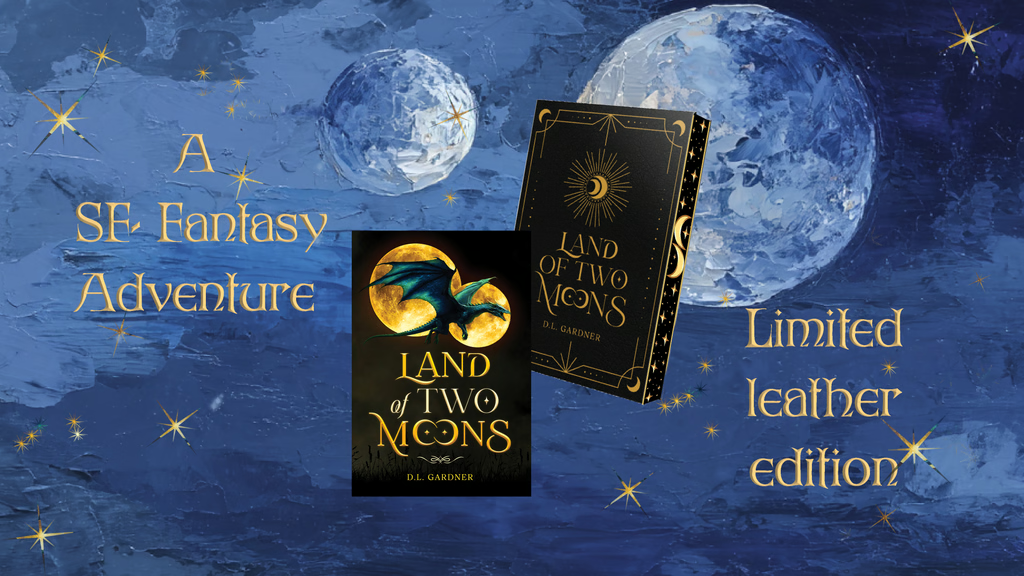
Affer was once a peaceful planet, until a war broke out between its six
inhabiting species. The humans, who were once the mightiest force on Affer,
were massacred in droves, and the ones who survived the onslaught were reduced
to mere slaves. The five other species divided the humans amongst themselves
and returned to their respective kingdoms.
The years passed, turning into decades and centuries, without any change.
Eventually, the humans had accepted their fate as slaves. All except one. Four
hundred and seventy-three years later, Fletcher Rush starts his journey to
free his kind…and conquer the planet.
About the Author
I’ve always had a love for fantasy, and to this day LOTR and The
Inheritance Cycle remain some of my favorite books. There are limitless
possibilities when you’re writing, but with fantasy, it’s different. You don’t
have to adhere to rules or logic; you can create whatever type of world you
want. Characters can live in a dystopian society, a grand futuristic city, a
picture-perfect world, or a medieval wasteland. Time, technology, and magic
are all there for the taking, and as a writer, you get to choose what defines
your story.
This is a selection of short stories perfect for the dark, cold nights
of the Christmas season. Each warm tale is set on Christmas Eve and is best
enjoyed from a comfortable armchair by the fireside, as the special ambience
of Christmas fills the room and our hearts.
Within these six stories, you will discover a rich variety of seasonal magic.
One tale takes you to a snowbound ancestral home, where family secrets are
finally revealed beneath a blanket of white. Another follows a German refugee
in the 1940s who, by joining the local junior football team, finds hope and a
sense of belonging during the festive period.
You’ll also encounter unexpected meetings at a lonely country crossroads,
where characters’ destinies become entwined on the most magical night of the
year. The collection journeys further afield to the warmth and wonder of an
Australian Christmas, where high summer temperatures provide a striking
contrast to the traditional spirit of the season.
One story features two old neighbours returning to their hometown, doing their
utmost to recreate the cherished Christmases of years gone by. Each narrative
offers its own unique perspective on the joy, togetherness and wonder that
define this special time of year.
This book is lovingly crafted for readers of all ages and backgrounds who
delight in the spirit of Christmas. Let these stories bring warmth and festive
cheer into your home.
About the Author
Steve’s interest in writing came from the early 1970s when his somewhat
unconventional English teacher encouraged his creativity. His creativity and
imagination went back however to childhood when he would create stories and
draw them in a series of pictures. He has always had a strong interest in
History and music. As a teenager he composed many songs but never met with
success his creative abilities were slowly channeled into writing books.His
first Novel ” A Cafe In Arcadia”,about life in an insular Greek town, was
published in 2014. He had already published ” The Christmas Tree Of Tales ” in
2013 under the name S R Kerr Under the same name,he also published another
book of short stories for Christmas,”It Came Upon One Christmas Eve”..In 2021
he published another novel “The Winding Streets Of Kolonaki” set in
Athens..His last book to be published was the non-fiction Eurovision ;A Plea
For Respect(Continental Songs And British attitudes). He counts a love of
music in his interests as well as travel and reading. He has travelled
extensivly to places as diverse as Pakistan and Peru and hopes to visit Japan,
Hong Kong and the USA in the near future. Growing up next to the beach on the
River Tay in his home town was a a major influence on him as was living in a
castle. He was always interested in anthropology and visiting other countries
where he often immersed himself in their culture. Places he visited and lived
in inspired much of his writing, as did his interest in psychology, people
watching. He worked as a lecturer, tutor, journalist ,civil servant in London
where at a point he shared a house with the group The Test Department. He is
at the moment working on three other books 1)Short Stories For Christmas 3)The
afternoons of Sanjay Bassinger. 4.)The Golden Road To Glyfada
A gangster’s life is hard. As the youngest son of a Chicago mobster lord, Fionn O’Grady is no stranger to crime, even though he’s clean and renowned for kissing rather than fighting. It’s a lonely life for a pizza-loving redhead. All he’s ever wanted is an easy-going boyfriend who doesn’t take life too seriously. It’s too bad that no man will date him because of his family.
Trouble comes when a UK undercover cop infiltrates the O’Grady mansion. According to the family, it’s up to Fionn to gain revenge by kidnapping the cop’s kid brother. Kidnap? Fionn couldn’t hurt anyone, certainly not a handsome young man needing a caring boyfriend.
As the chaotic brother of an undercover cop, Oli Green is endlessly fascinated by gangsters, particularly pizza-loving redheads. At twenty, Oli’s no kid—he fantasises about being kidnapped by a gentle gangster to guide him through his first time. Bonus points for emo villains! Above all, Oli wants an easy-going boyfriend who doesn’t take life too seriously…
Fionn and Oli fall together as the gangster lord tightens his net around them. Is Fionn strong enough to decide what matters most—family honour or the tug of his heart?
Fionn O’Grady was working at a figurine factory in Boston when the boss yelled him into the office.
“Miller. In here now.”
The other workers nudged one another knowingly. “Told you,” one of them muttered, evading Fionn’s questioning, startled gaze.
A familiar shiver traversed Fionn’s spine. It was the end of an eight-hour shift, and he was exhausted. Still, he liked to finish his art before knocking off for the day. Carefully, almost lovingly, he placed his paintbrush across the soldier figurine’s feet with a “Back soon” before scurrying into the office. He silently prayed he wasn’t facing unemployment again.
Inside the office, the boss loomed, disgust plastered across his face. He threw rather than handed Fionn a paper wallet. “Here are your documents, Tom Miller. Now scram, O’Grady scum. Did you think I wouldn’t find out who you are? I don’t hire gangsters, even ones with your painting skills. Scram.”
Fionn didn’t ask how the boss had discovered his identity. Nor did he challenge Mr Moss’s choice of words—‘scram’—for a worker who’d single-handedly painted a battalion of figurine soldiers in one day. There’d be no point now that Mr Moss knew who Fionn was.
“All right, then. The final soldier needs a varnish.”
Fionn grabbed his coat and exited the factory with a sickening sensation; the concrete beneath his feet tried to suck him into the bowels of the earth, down, down, down. He wished there were someone he might call, a friend to share the load, maybe even a boyfriend. But there was nobody.
At the bus stop, he waited in line behind two jostling teenage boys. Their youthful skirmish soon turned into passionate necking. Maybe the hormonal steam rising from the boys caused Fionn’s invisible armour to buckle and fall away one plate at a time.
Or maybe the breathlessness tearing suddenly at his throat was born not of longing but loss. Whatever the cause, the boys’ frantic energy caused an ache to spread, searing Fionn’s muscles and nerves and settling inside his chest. A catastrophic influx of emotion shattered his habitual numbness, rendering him vulnerable against a flood of memories and cravings he couldn’t name. Could it be nostalgia squeezing his lungs for the hopeful teen he’d once been, craving a kiss from the neighbour? Or was it something else?
In his head, the words, “You’re lonely,” shouted in his sister’s voice.
Fionn baulked. The reminder of his sister, followed by some talented graffiti that had been sprayed on a wall, snapped at his energy and will. One word in particular reminded him of the many countries he’d lived in without ever finding a home or an accent that felt right.
Outsider.
Maybe his changeable accent explained why he never fitted, no matter what. He’d been told at various times that he sounded Irish, Welsh, British, or American.
Lonely, his sister whispered again.
Fionn walked away from the graffiti, muttering to himself. Ach, sure, it’d been months since his boyfriend had left without a backwards glance, throwing cruel words impossible to forget. You’re related to the O’Grady scum? Don’t contact me again. Same old, same old. But it wasn’t as if Fionn was a stranger to hardship. On the contrary, he was well used to fleeing at midnight with two carrier bags. Therefore, the unexpected churning in his stomach and head made no sense at all.
Still, it took a grave effort to return to his customary state of numbness, to push aside the memory of his sister, Sinéad. The teenage boys now had their hands down each other’s jeans, not that Fionn cared, because he didn’t.
When it was his turn to board the bus, Fionn grabbed the handle to jump on.
The driver held up a hand, shouting, “No O’Gradys. You’re banned. This city has had enough.” Then he pointed at a poster on the window bearing the faces of Fionn’s family, his mugshot in the middle. As if the poster weren’t condemning enough, the passengers joined in the tirade of hatred by shouting and making rude gestures.
The bus driver sped away, leaving Fionn stranded. He stumbled backwards into a low wall, cheeks blazing, shame burning every inch of his freckled skin. Although he didn’t wish to know what his family had been up to now, he wouldn’t have minded knowing why the whole city had turned against him. In twenty-five years, Fionn had never been involved in crime, and he never would be.
Despair gripped his heart. How could one live without a job or money? The rent was due. He’d been relying on the wage from the figurine factory to tide him over until he made his fortune painting landscapes. Dad wouldn’t allow his youngest son back into the O’Grady home until Fionn agreed to work for the ‘business’. Mum was as bad as Dad, and his other siblings were older, each deeply immersed in the gangster underworld. The O’Gradys genuinely saw nothing wrong with their way of life. To them, he was the problem.
Despite the apocalypse gathering in his chest, it was a pleasant, warm evening. Spring wafted from hanging baskets and potted flowers: lavender, rose, lemon. Along with the scents, a heavy bout of sadness settled on Fionn. His beloved twin sister’s name was in his mouth before he could stop it. How could he help it? Though Sinéad had left years ago, Fionn still recognised a geranium from a petunia. His sister had loved floral scents, spending hours among flowers in the fields surrounding the family mansion. Her passion had naturally passed to her brother, who’d adored her.
Sinéad had been the clever one, running from the family at fifteen, never to return. If only the twins had saved enough money for two air tickets to England, Fionn would have fled with her, but they hadn’t managed it. By the time he’d earned enough to buy a flight from two paper rounds and night shifts at a paint factory, Fionn had forgotten the mobile number Sinéad forced him to memorise before she left. The numbers had jumbled in his anxious, ADHD brain alongside the fear of what Dad would do if he discovered the plan. For years, Fionn waited for Sinéad’s call. It never came. Ten years later, every pretty redhead resembled her.
He’d made many attempts over the years to locate his sis on social media, to no avail. She’d undoubtedly found a safer life under a new name. A nasty inner voice insisted she was better off without her brother anyway, since he was as chaotic as a giraffe on skates, fuelled by impulsivity and paper art.
Fortunately, Fionn kept an emergency packet of tissues in his pocket. Without it, he wouldn’t have survived the despair threatening to undo the façade of normality in which he survived.
He produced a tissue, ripped it into bits, and crafted a tiny bus. When he’d finished it, he felt immeasurably better. For Fionn, art represented a safety jacket when the storms appeared.
He propped up the paper bus on the wall where he’d collapsed, figuring someone else might need it. The panic faded, leaving a familiar determination to survive no matter the odds.
When he was able to breathe calmly, Fionn began the ten-mile walk home, expecting every tree to turn into a cop or, worse, a knife-wielding gangster. He was useless in a fight, yet beneath the anxiety, he yearned for a scrap like those he’d had with Sinéad as a child, fights that ended in laughter and a glass of fizzy pop. Since she’d left, life had become a pursuit of rent and bills rather than what it should have been: laughter, love, fun, fun, fun.
After miles of trudging, Fionn paused at a shop to buy a water bottle. The shopkeeper immediately slammed the door shut, pointing at a poster identical to the one on the bus. “Get lost, O’Grady!”
It was the final straw. Fionn sank onto a patch of grass, head in hands. His messy red hair falling into his eyes reminded him of his sister, whose long locks had once reached her bottom. Man, he missed her and the safety of family members he could trust.
Not even emergency tissues saved him from the brink of hopelessness. He hit rock bottom on the grass amidst the scent of summer flowers. Moments passed into hours.
Fortunately, the mental darkness never lasted long. Finally, a tiny light appeared, growing brighter every second.
Fionn recognised the light as a need for action, which, in turn, would shatter the awful greyness threatening to undo him. The urge to move, to fill the empty void, wasn’t new or without risk. He’d always been impulsive, even reckless. Mostly, he recognised the craving for what it was—part of his ADHD—but sometimes, he trusted his instincts despite the consequences.
A risky idea danced into his mind provocatively. Instead of heading to his apartment, he could walk to the family mansion, which was nearby, and confront his parents. After all, there was nothing left to lose. The visage of a repentant scene, where Dad begged for forgiveness, teased Fionn mercilessly: I missed you, son.
The temptation to return home quickly became too great to ignore. Fionn told himself he only wanted to see the family one last time. Yeah, it was time to confront them and then leave the city to start anew elsewhere. He should’ve done so ages ago. Surely Dad wouldn’t deny his youngest child a second chance? The great gang lord might offer to help contact Sinéad, wherever she was. Dad was a stubborn ass, but he’d always loved the twins—up until they’d begun saying no, anyway.
Fionn walked quickly towards his childhood home. By nature, he was cheerful and optimistic. The city had got him down, but things would improve once he got away. A long time ago, he’d forgiven his parents for throwing him out and his siblings for shunning him. Fionn had been born with a generous nature not even the O’Gradys had quenched.
Thirst and a wave of panic at the far end of the O’Grady driveway forced Fionn to a halt. It had been a year since the Sunday dinner when Dad offered him a job hacking into a bank.
“Easy work, son,” Dad had said. “Time you settled down and moved back with the family instead of slumming it in the seedy shithole you call home. My son working in a paint factory? No. You make me a laughing stock.”
Fionn had tried hard to stay calm, to stick to his guns. “Dad, no. I don’t want anything to do with crime, remember? I’m happy where I am in life. Okay? I’m different from you, but it doesn’t mean we can’t still get along. We’re family—right?” Fionn had laughed. Most people experienced the same conversation with their parents, albeit with different issues. Whereas school friends had negotiated bedtime, Sinéad and Fionn had argued about firearms.
His father had turned his back, beefy arms crossed, neck rigid with anger. “You break my heart. Get out of here. Don’t come back.”
Fionn had stupidly tried to reason with him, tugging at Dad’s arm, trying to make peace as always. “Dad? Can’t we talk about it?”
The awful scene ended abruptly when the family security guard, a tall woman with tattoos, dragged Fionn across the room before hurling him outside into the rain. She turned once before locking the family home.
“You heard the boss,” she’d said. “You’re rubbish.”
Fionn was left homeless, bitter jealousy souring his heart. What kind of father preferred a security guard to his own son?
“No, you’re rubbish,” he’d shouted futilely. But it was too late. The guard had already locked the door and drawn the blinds. Nobody wanted to hear what Fionn had to say, never mind act upon his wishes.
With hindsight, Fionn wished he could’ve accepted the job and made his father happy; he really did. He loved his dad and still craved the gang lord’s approval and love. But crime? Fionn couldn’t partake then or now. One hacking job would lead to another. Anyway, he was pants at anything like that. All Fionn had ever been good at was art and snuggles.
The painful memory of being thrown out of the family home immobilised him. It took a while before Fionn could wipe his face and walk down the driveway towards the family mansion, so thirsty not even the memory of Dad’s final haunting words slowed his progress. You’re an embarrassment.
It was a surprise to find the front door wide open. Mum never left the door open. Instinctively, Fionn knew something was very wrong. A black, ragged hole opened up within his chest. As children, he and Sinéad had always feared retribution, stabbings, and worse.
He rushed forward despite the danger, expecting to find the bodies of his family strewn across the living room.
Instead, the security guard who’d thrown him out months ago appeared and rugby-tackled him to the ground with a snarl.
Grass cuttings, earth, and flowers smacked Fionn in the face. He soon stopped fighting back. “For fuck’s sake. What is it with you and beating me up? Get off me,” he gasped.
The guard straddled him, holding his hands above his head, intent on winning. “Fionn O’Grady, at last. We’ve been waiting for you. As with the rest of the O’Grady scum, you’re under arrest. Time to pay for your crimes, rubbish. This town has had enough.”
With a quick flick of her wrist, she held up a police identity card bearing her photo and name. Charlie Green.
Eule Grey has settled, for now, in the north UK. She’s worked in education, justice, youth work, and even tried her hand at butter-spreading in a sandwich factory. Sadly, she wasn’t much good at any of them!
She writes novels, novellas, poetry, and a messy combination of all three. Nothing about Eule is tidy but she rocks a boogie on a Saturday night!
For now, Eule is she/her or they/them. Eule has not yet arrived at a pronoun that feels right.
A strange boy. A shortwave radio broadcasting numbers. A kidnapping
plot.
Tahra Mamoun uses her power of remote viewing to escape the monotony of
London, only to find herself trapped in the frozen tensions of East Berlin.
There, she witnesses a spy drama unfolding around teenage Heinrich and his
illegal shortwave radio: a device receiving messages from a clandestine
numbers station.
Is it connected to his missing father? And will the Stasi kidnap the boy as an
asset designed to serve the secret police?
Thrust into the heart of a Cold War conspiracy, Tahra must rely on her friend
Edward to warn his mother. But how can one girl’s mind save his family?
Christmas traditions, old and new from Sgt. Windflower and his family and friends.
Title: CHRISTMAS IN NEWFOUNDLAND 3
Author: Mike Martin
Publisher: Ottawa Press and Publishing
Pages: 160
Genre: Mystery/HolidayFiction
Format: Paperback / Kindle / FREE on Kindle Unlimited
Sgt. Windflower loves Christmas and we’re happy to share what he and his family and friends do at Christmastime in Grand Bank or Marystown or Ramea, Newfoundland. Some of the stories feature Windflower and Sheila’s adorable daughters and of course Eddie Tizzard and his family make several spotlight appearances. Other stories take you back to Christmas seasons of many years long past and there’s even a return of a fabulous Newfoundland tradition, the Mummers.
Christmas is a time to celebrate but it is also a time to reminisce and remember. We hope that it will bring back pleasant memories for you and your family to share at Christmas andthroughout the year. Come celebrate Christmas in Newfoundland with Sgt. Windflower Mysteries.
Richard Tizzard gazed out at the ocean from his small home in Grand Bank, Newfoundland. The wind was high, and the waves were crashing against the shore, sending spray up into the air. Already, his house had a thick coating of the stuff on the side facing the water and he could hear it creaking and groaning against this relentless onslaught.
But inside, with the wood stove piled high, Richard and his old dog, Rusty, were perfectly comfortable and content. Both of them were coming to the end of their lives and Richard had accepted that almost completely. His children were trying to keep him hanging on as long as possible, but he was fine with what he knew was an inevitable outcome.
He loved the quote by the great Bengali poet, Rabindranath Tagore that his friend, Doctor Vijay Sanjay had shared with him. He smiled to himself as he repeated it to Rusty. “’Death is not extinguishing the light; it is putting out the lamp as dawn has come’.” Rusty seemed to smile, too, at this saying.
It wasn’t that he wanted to go, but Richard Tizzard was getting himself ready. In the meantime, he planned to enjoy his family to the upmost. His two daughters, Margaret and Brenda lived in Grand Bank with their almost grown-up families. His son, Eddie, lived in Marystown now with his wife Carrie and their two children. Little Hughie was almost two and the joy of Richard’s life while the baby, Sophie, was quickly overtaking her brother as his favourite.
He smiled again when he thought about Eddie and his young family. It reminded him of when he had a young family of his own back in the tiny community of Ramea. Ramea is and was a small village off the southwest coast of Newfoundland that was only accessible by ferry. It did, however, have a rich fishing ground nearby and for many years provided a good livelihood for Richard and his four brothers, all of whom fished the abundant waters for many years.
But in the early 1990’s the inshore cod fishery collapsed and by 1992, when the cod moratorium was declared, all of them were out of work. The older brothers retired their boats and licenses and took the government support that was offered. Richard was too young for that, so he used the payout to move to Grand Bank. First, he worked in the fishing industry on a crew of a longliner operating out of Marystown. But when that work diminished, he went back to his true love, carpentry and woodworking.
He still did a little personal work on the side but his days of working for a living were over. He enjoyed all his family and the grandchildren tremendously, but the truth was that all he had left today were memories. Like many older people he spent a lot of time reminiscing and remembering these days. And as it was getting near Christmas, he thought a lot about Christmas from his past.
Growing up in his mom and dad’s saltbox house in Ramea. Christmas was a very quiet and peaceful affair. But he still remembered it fondly as one of the nicest times of the year. His father and older brothers were fishermen, so the winter was a slow season. They fixed their nets and did a few odd jobs around the house, but most of their time was spent cutting and splitting wood for the cast iron woodstove that heated their home and was action central for all cooking and baking.
About two weeks before Christmas his mother would start her Christmas baking. Shortbread cookies, mince pies and next year’s Christmas cakes. This year’s cakes were all ready to be unwrapped in a week or so and that would begin the ‘season of eating’ his dad called it. Richard loved the smell of the cookies and cakes as the days went by and to hear his mother singing, usually some old hymn or Christmas song like Angels We Have Heard on High or Away in a Manger.
The men would continue their work as usual until a few days before Christmas Day. Then, his father would announce that it was time to get their tree and the whole family, except his mother, who was almost literally chained to the stove in the kitchen, would head out with their horse and sleigh to find a Christmas tree. They didn’t have to go far.
The houses in Ramea were built mostly around the harbour in sheltered nooks and crannies out of the constant wind. That meant almost all the land above them was still heavily forested with an abundance of Balsam firs that made the perfect Christmas trees. His father would lead the procession into the forest, but the tradition in the Tizzard family was that all the children would draw straws to see would pick their tree. The year Richard drew the shortest straw he was so excited he almost peed his pants.
As the others urged him on, making suggestions, Richard took a deep breath and closed his eyes. When he opened them and turned around, he saw it. A six-foot Balsam fir with many branches that spread out from top to bottom. “That’s it,” he cried, and everyone cheered. They cut it down and put it on the back of the sleigh to go home. When they arrived, their mom had made a pot of hot cocoa and while the tree was drying out in a corner they sat around and enjoyed their sweet, hot treat with some home-made cookies.
When Richard closed his eyes today, he could still smell that Christmas tree in their kitchen and taste that delicious hot cocoa. He remembered his mom sitting by herself next to the stove smiling. That was one of her last Christmas holidays with them, he recalled. She died like so many others at that time from complications in the birth of his youngest sister. Christmas was never quite the same in their household after that.
– Excerpted from Christmas in Newfoundland 3 by Mike Martin, Ottawa Press and Publishing, 2025. Reprinted with permission.
About the Author
Mike Martin
was born in St. John’s, NL on the east coast of Canada and now lives
and works in Ottawa, Ontario. He is a long-time freelance writer and his
articles and essays have appeared in newspapers, magazines and online
across Canada as well as in the United States and New Zealand.
He is the award-winning author of the best-selling Sgt. Windflower Mystery series, set in beautiful Grand Bank. There are now 16 books in this light mystery series with the publication of Friends are Forever.
A Tangled Web was shortlisted in 2017 for the best light mystery of the year, and Darkest Before the Dawnwon the 2019 Bony Blithe Light Mystery Award.All That Glitters was shortlisted for the LOLA 2024 Must Read Book of the year award.
Some Sgt. Windflower Mysteries are now available as audiobooks and the latest Darkest Before the Dawn was released as an audiobook in 2024. All audiobooks are available from Audible in Canada and around the world.
Mike is Past Chair of the Board of
Crime Writers of Canada, a national organization promoting Canadian
crime and mystery writers and a member of the Newfoundland Writers’
Guild and Capital Crime Writers.
His latest book is Christmas in Newfoundland 3: Sgt. Windflower Holiday Tales.
A contract of power. A marriage of enemies. A love written in blood,
bound by desire.
Caterina: My father thinks he owns me. A spoiled mafia princess, good for one
thing — marriage to strengthen his empire. But I refuse to be sold to a cruel
man. If he wants an alliance, I’ll give him one — on my terms. So I go
to Dante De Luca, the De Luca family’s most dangerous enforcer. Cold.
Controlled. Lethal. Our contract marriage is supposed to be business, not
desire. Then he touches me, and everything I thought I knew about power and
control shatters.
Dante: Caterina Lombardi doesn’t know what she’s started. She
wants protection. I want her. She thinks she can use me to defy her father,
but once she’s mine, she stays mine. She’s fire wrapped in silk —
reckless, beautiful, and born to test every rule I’ve ever followed. But
in our world, rebellion comes with blood, and enemies are closing in.
I’ll burn everything to protect her… even if it means becoming
the monster she fears.
A dark mafia romance filled with obsession, betrayal, and dangerous passion.
For readers who love possessive alpha heroes, spoiled princess heroines,
enemies-to-lovers heat, and contracts written in blood.
WARNING: Intended for readers 18+ The Enforcer’s Possession includes
dark and possessive elements, emotional intensity, and morally gray behavior.
EXCERPT
Caterina
I sprawled across the velvet chaise near my bedroom windows, one leg dangling
over the armrest, my phone pressed to my ear while Adriana went on about some
party at the Castellano estate. I wasn’t really listening. Instead, I
picked at the silk blouse I’d tossed aside an hour ago — Valentino,
bought last week, already boring — and let my gaze drift across the disaster
zone my room had become.
Designer clothes lay scattered across the marble floors like expensive
casualties. A Gucci dress hung half-off my bed frame. Three pairs of
Louboutins created a hazardous path to my bathroom. My jewelry cases sat open
on every available surface, catching the afternoon light and throwing rainbow
refractions across the walls.
“Cat? Are you even listening to me?”
“Hmm?” I shifted, letting the blouse fall to the floor.
“Sorry, what?”
“I said Marco asked about you. Again.” Adriana’s voice held
that knowing tone that made me want to reach through the phone and smack her.
“He wants to know if you’ll be at –”
“Tell Marco to go fuck himself.” I sat up, reaching for my
discarded iced coffee on the side table. Watered down. Disgusting. I set it
back without drinking. “I’m not interested in whatever trust fund
baby wants to play gangster this week.”
“He’s not that bad.”
“He wore a fedora to Lucia’s birthday party. A fedora, Adi.”
She laughed, and I felt myself smile despite my mood. That was the thing about
Adriana — she got it. She understood what it was like to live in this world,
to be decorative and controlled and expected to smile through it all.
“Fair point,” she said. “So what’s got you in such a
charming mood today? And don’t say nothing, because I can hear it in
your voice.”
I stood, pacing toward my walk-in closet. The motion felt good, gave me
something to do with the restless energy crawling under my skin. “My
father. What else?”
“What did Giuseppe do now?”
“He’s acting like I’m some prized mare to be traded off to
the highest bidder.” I stepped into the closet, running my hand along
the row of couture gowns that lined one wall. Versace, Dolce & Gabbana,
Armani — thousands of dollars of fabric I was expected to wear while playing
the dutiful daughter. “Apparently, he’s been having meetings.
About my future.”
“Meetings.” Adriana’s voice went flat. She knew what that
meant. We all did.
“With families. Old families. Traditional families who think women
should be seen and not heard.” I grabbed a dress at random — something
in emerald green I’d worn once to a charity gala — and pulled it off
its hanger. Held it up. Put it back. Wrong. All wrong. “He actually told
me yesterday that it was time I started thinking about settling down. Settling
down. I’m twenty-one, not forty.”
“What did you say?”
“I told him I’d rather die.”
Adriana sucked in a breath. “Cat. You didn’t.”
“I did.” I moved to my vanity table, surveying the collection of
high-end makeup and perfumes arranged across its surface. My reflection stared
back at me from the mirror — dark hair falling in waves past my shoulders,
green eyes sharp with anger I couldn’t quite bank. I looked like my
mother had at my age, according to the photos. Before Papa had worn her down
into the perfect Mafia wife. “He didn’t appreciate it.”
“I’m shocked.”
“The thing is, he doesn’t even see it. Doesn’t see how
fucking archaic it all is.” I picked up a lipstick, twisted it open,
then put on a little across my lips. “We all know he’s doing this
for himself or the family, but I’m sure part of him also thinks
he’s protecting me. Providing for me. Making sure I’m taken care
of.”
“By selling you off to some capo’s son?”
“Basically.” I walked back to the windows, looking out over the
Lombardi estate gardens. Perfectly manicured hedges, marble fountains, rose
bushes that cost more to maintain than most people made in a year. Beautiful.
Like a gilded cage. “He keeps talking about duty and family and legacy.
As if I’m just another asset to be leveraged. At the same time, I know
he feels women are inferior. I’m sure he doesn’t believe I could
ever take care of myself.”
“You are, though. To him.” Adriana’s voice was gentle, which
somehow made it worse. “In his world, that’s what daughters are
for.”
I pressed my forehead against the cool glass. “I know. That’s what
makes it so Goddamn frustrating. He genuinely believes he’s doing right
by me. That finding me a wealthy, connected husband is the best thing he can
offer.”
“What about what you want?”
“What I want doesn’t factor into the equation.” I turned
away from the window, surveying my room again. The luxury that surrounded me
suddenly felt suffocating rather than comfortable. “I’m a
Lombardi. I’m supposed to want what’s best for the family.”
“And what do you want?”
The question hung in the air. I didn’t have a good answer. I wanted
freedom, but freedom to do what? I’d never had to think about it before.
My life had always been mapped out — private schools, designer clothes,
carefully curated social events, and eventually a marriage that would
strengthen family alliances.
“I want to choose,” I said finally. “I want to choose who I
fuck, who I marry if I marry, what I do with my life. Is that too much to
ask?”
“For Giuseppe? Probably.”
I laughed, but it came out bitter. Moving back to the chaise, I dropped onto
it dramatically, throwing one arm over my eyes. “He’s been worse
lately. More controlling. Like he knows something I don’t.”
“Maybe he does.”
“That’s what I’m afraid of.” I let my arm fall,
staring at the ceiling. The fresco up there — some Renaissance reproduction
that had cost a fortune — suddenly seemed ridiculous. Everything in this room
was ridiculous. Beautiful and expensive and utterly meaningless. “I can
feel it, Adi. Something’s coming. Some decision he’s already made
that’s going to change everything.”
“Have you tried talking to him? Actually talking, not just
fighting?”
“You can’t talk to Papa. You can plead your case and then watch
him do whatever he was going to do anyway.” I sat up, running my fingers
through my hair. My diamond bracelet caught on a strand and I yanked it free
with more force than necessary. “He pretends to listen, nods in all the
right places, and then completely ignores everything you’ve said.”
“What about Sofia?”
“Mama?” I snorted. “She’s worse. At least Papa is
honest about being a controlling bastard. Mama just smiles and suggests I try
being more accommodating. More understanding of the family’s
needs.”
“Ouch.”
“Yeah.” I stood again, unable to stay still. The restless energy
was back, stronger now. I moved to one of my jewelry cases, running my fingers
over the pieces inside. Tiffany, Cartier, Bulgari — gifts from my father,
purchased with blood money and given with the expectation of gratitude.
“She’s been doing this so long she doesn’t even see it
anymore. The way she swallows her opinions, plays the perfect hostess,
pretends not to notice when Papa comes home with blood on his cuffs.”
“Is that what you’re afraid of? Turning into her?”
The question hit too close to home. I closed the jewelry case with a sharp
snap. “I’d rather die,” I said again, and this time I meant
it with everything in me.
“Well, don’t do that. Your funeral would be boring and I’d
have to wear black, which washes me out.”
Despite everything, I smiled. “You’re the worst.”
“I’m the best and you know it.” I could hear her moving
around on her end, probably getting ready for whatever evening plans she had.
“Look, I know you don’t want advice –”
“Then don’t give it.”
“– but maybe pick your battles. Giuseppe’s old school.
You’re not going to change his mind by going head-to-head with him every
time.”
“So what, I should just roll over and accept whatever he decides?”
“No. I’m saying be smart about it. You’re clever, Cat.
Probably the smartest person I know, even if you are a spoiled brat.”
“Fuck you.”
“Love you too. My point is, if you’re going to fight him, make it
count. Don’t waste your energy on every little thing.”
I wanted to argue, but she wasn’t wrong. Papa responded to strength, to
strategy. Throwing tantrums — no matter how justified — just made him
dismiss me as a child. “Fine. I’ll be strategic.”
“Liar. You’re going to do something dramatic and probably get
yourself grounded, aren’t you?”
“Probably.” I glanced at my closet, an idea already forming.
“There’s a family dinner tonight. Something important, based on
how tense everyone’s been.”
“Oh no.”
“Oh yes.”
“Caterina Lombardi, whatever you’re planning –”
“Gotta go, my warden’s here.” I’d heard the footsteps
in the hall, recognized my mother’s measured pace. “I’ll
call you later.”
“Don’t do anything I wouldn’t do.”
“That leaves me a lot of options.” I ended the call, dropping my
phone onto the chaise just as my bedroom door opened.
Mama swept into my room like she was entering a ballroom, her posture so
perfect it made my spine hurt just looking at her. She wore a cream-colored
Chanel suit that probably cost more than a compact car, paired with pearls
that had been in the family for three generations. Every dark hair sat exactly
where it was supposed to. Not a wrinkle in sight. She looked like the poster
child for “Mafia wife perfection,” and it made me want to scream.
Her gaze traveled across the disaster of my room — the scattered clothes, the
open jewelry cases, the general chaos — but her expression remained serene.
That was Sofia Lombardi’s superpower. Nothing ruffled her. Ever.
“Caterina.” She said my name like it was a complete sentence, with
just enough weight to convey disappointment without actually expressing it.
“Mama.” I stayed where I was on the chaise, not bothering to sit
up straighter or pretend I was doing anything productive. Let her see the
mess. Let her judge it. I didn’t care.
That was a lie. I cared. But I’d rather die than admit it.
“I wanted to remind you about tonight’s dinner.” She stepped
farther into the room, her heels clicking precisely against the marble. Even
her footsteps were measured. “Your father expects everyone to be present
and properly dressed by seven.”
“Properly dressed.” I let the words hang in the air between us,
loaded with all the implications they carried. “You mean demure and
obedient? Quiet and decorative?”
“I mean appropriate for a family gathering.” Her tone remained
gentle, but I caught the steel underneath. Mama had spent twenty-some years
perfecting the art of being firm while sounding pleasant. “We have
important guests coming.”
“Of course we do.” I sat up, swinging my legs off the chaise with
deliberate carelessness. One of my discarded shoes clattered across the floor.
“Let me guess. Someone essential. Someone whose opinion matters. Someone
Papa wants to impress.”
Mama’s lips pressed together for just a moment — the only crack in her
composure. “This is vital to your father.”
“Everything is a key component to Papa. His reputation, his alliances,
his legacy.” I stood, moving to my vanity and picking up a bottle of
perfume just to have something to do with my hands. “His ability to
control every aspect of his daughter’s life.”
“Caterina.” This time my name came with a sigh, and when I glanced
at her reflection in the mirror, I saw something that might have been
weariness in her eyes. “Must you make everything a battle?”
“Must he treat me like property?” I set the perfume down harder
than necessary. The glass bottle made a sharp sound against the marble vanity
top. “I’m not a business asset, Mama. I’m a person.”
“No one said you weren’t.”
“They don’t have to say it. They just act like it.” I turned
to face her directly, crossing my arms. “Do you know what he told me
last week? That it was time I started considering my options. My options. Like
I’m shopping for a new car instead of thinking about my future.”
Mama moved to my bed, perching on the edge with practiced grace. Even sitting
casually, she looked like she was posing for a portrait. “Your father
wants what’s best for you.”
“What’s best for the family, you mean.”
“Sometimes those things align.”
“And when they don’t?” I challenged. “What happens
when what’s best for the family means sacrificing what I want? What I
need?”
She looked at me then, really looked at me, and for a moment I saw something
genuine beneath the polished exterior. Regret, maybe. Or recognition.
“We all make sacrifices, Caterina. That’s what it means to be part
of something larger than ourselves.”
“I didn’t ask to be part of this.” My voice came out sharper
than I intended. “I didn’t choose the Lombardi name. I
didn’t choose this life.”
“None of us do.” She stood, smoothing her skirt even though it
didn’t need smoothing. “But it’s the life we have. The
question is what we do with it.”
I wanted to argue more, to push until that perfect composure cracked and she
admitted how much she’d given up, how much she’d swallowed to be
Giuseppe Lombardi’s wife. But I also knew it was pointless. Mama had
made her peace with her choices a long time ago. She’d decided that
compliance was easier than resistance, that playing the role was safer than
fighting the script.
I’d never be able to do the same.
“Seven o’clock,” she said again, moving toward the door.
“Please don’t be late. And, Caterina?” She paused, her hand
on the doorknob. “Wear something appropriate.”
I drummed my manicured nails against the vanity top, the sharp click-click-click filling the silence. It was a nervous habit I’d never
been able to break, and one that drove my father crazy. Mama’s gaze
flicked to my hand, but she said nothing. Just waited.
“I’ll be there,” I said finally. “Properly dressed and
everything.”
Something in my tone must have warned her, because her eyes narrowed slightly.
Not angry, just… knowing. She’d raised me, after all. She knew
when I was planning something.
“Caterina –”
“I said I’ll be there.” I gave her my sweetest smile, the
one I used when I was about to do something that would make Papa’s blood
pressure spike. “You can count on me.”
About the Author
Harley Wylde is an accomplished author known for her captivating MC Romances.
With an unwavering commitment to sensual storytelling, Wylde immerses her
readers in an exciting world of fierce men and irresistible women. Her works
exude passion, danger, and gritty realism, while still managing to end on a
satisfying note each time.
When not crafting her tales, Wylde spends her time brainstorming new
plotlines, indulging in a hot cup of Starbucks, or delving into a good book.
She has a particular affinity for supernatural horror literature and movies.
Visit Wylde’s website to learn more about her works and upcoming events, and
don’t forget to sign up for her newsletter to receive exclusive discounts and
other exciting perks.
Author on Facebook, Instagram, & TikTok: @harleywylde
Publisher on Facebook, Instagram, Twitter, and TikTok: @changelingpress
Save 15% off any order at ChangelingPress.com with code RABT15
A Sabre in the Hemlock Dorothy Dreyer (Blade Bound Saga, #2) Publication date: November 18th 2025 Genres: Adult, Fantasy, Romance
With enemies closing in and magic slipping from her control, Celeste draws closer to unraveling a prophecy that could cost her the man she loves—as well as her soul.
In the wake of the carnoraxis attack on Ivystone Citadel, Celeste Westergaard’s battle for her future has only just begun. Trapped under the king’s watchful eye and hiding the magic awakening within her, Celeste must play the role expected of her, all the while uncovering secrets buried throughout Terre Ferique.
As the royal court embarks on a tour to solidify Dante’s claim to legitimacy, whispers of war and treachery follow their every step. The Shadow Tsar’s reach is growing, and the prophecy that fuels his reign foretells the rise of a power that will bring his downfall—one tied to the blood of the fae.
From glittering courts to bloodstained battlefields, Celeste must walk a knife’s edge between duty and desire, deception and truth. Because if the tsar discovers who she really is, he won’t just come for her magic, he’ll come for her soul.
A Sabre in the Hemlock is the thrilling sequel to the award-winning A Dagger in the Ivy, weaving romance, danger, and dark intrigue into an unforgettable tale of power and sacrifice.
“You promised you wouldn’t,” he says, voice quiet but taut, threaded with frustration. “You said you’d wait. You said you’d let Ezra figure it out.”
“I never promised,” I snap back, chin lifting. “You asked me not to, but I never agreed.”
“You bled, Celeste.” He leans closer, his voice low, heated. “I could tell something was wrong, even from the water. And what I couldn’t see, Nadya filled me in on.”
Of course she did.
“I had to help you.” The words come out louder than I intend, sharp with the emotion I’ve been burying all day. “They sent armed soldiers after you. You were bleeding underwater. You could have been pummeled by a f***ing tsunami. You don’t get to ask me to sit and watch you die.”
His hands flex, fists clenching just beneath the surface. “And what if helping me had killed you instead?”
I stare at him, my breath shallow. I don’t have an answer—not one that would make him feel better.
He paces a few steps through the water, raking a hand through his hair until it curls wild and damp around his temples. “Gods, you’re so damn stubborn.”
“And you’re so damn arrogant if you think you can tell me when and how I’m allowed to use a power that’s mine.”
He turns sharply, water sluicing off his chest, his gaze fierce enough to stop me in place. He crosses the space between us with quick, sure strides—and suddenly, he’s there, his hands finding me beneath the water, one arm locking around my waist, the other curling so that his hand is tugging the hair at the nape of my neck.
The heat of him burns through the chill. My breath stutters.
“Of course you’d fight me,” he mutters, his voice hoarse against my cheek. “Even when I’m trying to protect you.”
“And of course you’d push me,” I breathe back, “even when I’m trying to save you.”
The air thrums between us, thick with something neither of us is willing to yield. My pulse hammers as his thumb grazes the side of my throat, slow and reverent, like he’s trying to memorize the beat of my heart.
“I told you,” he says, his forehead almost brushing mine, “you bleed for no one.”
“And I told you,” I whisper, “you don’t get to decide that.”
His jaw tightens—and then, in one breath, his lips are on mine.
Author Bio:
Dorothy Dreyer is a Philippine-born American living in Germany with her family. She is an award-winning, USA Today Bestselling Author of fantasy, romance, and horror books that usually have some element of magic or the supernatural in them. Aside from reading, she enjoys movies, binge-watching series, chocolate, take-out, traveling, and having fun with friends and family. She tends to sing sometimes, too, so keep her away from your Karaoke bars.
NYT and USA Today Bestselling author Kaylee Ryan brings you a new standalone series surrounding the Nashville Rampage football team. Follow the Play is a single dad, nanny, friends-to-lovers, forced proximity sports romance.
Baker
Being a single dad was never part of the playbook, but one look at my son and everything changed.
Now football and fatherhood are my whole world—a world that gets turned upside down when my nanny quits two weeks before training camp.
Sloane Peterson runs interference by stepping in to help.
She’s sweet, dependable, and the one woman I shouldn’t want. Not when our lives are so entwined.
But every time she smiles at my son—or me—it gets harder to remember that our little arrangement is only temporary.
Sloane
Taking a short-term nanny gig for Nashville Rampage’s most eligible DILF has disaster written all over it.
But when Daddy Sin is in a bind, I do just that. It keeps me from waiting tables, and his son is the cutest little boy on the planet.
Baker Sinclair is famous, has a body like a Greek god, and when he’s in daddy mode… he’s irresistible. He’s also currently my new boss, and completely forbidden.
The longer I’m in his home, the less this feels like a job.
Because between reading bedtime stories and baking cookies, I can’t imagine my life without them… either of them. Too bad love doesn’t follow lesson plans… or playbooks.
New York Times and USA Today Bestselling author Kaylee Ryan has been crowned the Queen of Swoon by her readers. With nearly fifty romance books under her belt, she’s known for penning happily ever afters with heart. When she’s not writing, you can find her with a book in her hand or hanging out with her family where she resides in her home state of Ohio.
Storm, born of an esteemed lineage, avoids the violent
politics of his species until the power struggle comes to him. After being
attacked while traveling home, he overcame his assailant. Wounded and
vulnerable, Storm retreats into a cave to heal, only to be woken from a healing
sleep by a band of cutthroats intent on taking his hide.
Selah has been kidnapped. The thugs wanted an elven mindhealer, but she is only
an apprentice. Now her captors are insisting she slay a dragon for them by
addling its mind. To refuse means death for her, but to comply would be death
of a different kind.
Captive Dragon is a
noblebright fantasy romance novel about a relationship between a dragon shifter
and a warrior elf. It features an alpha/cinnamon roll of a reluctant hero and
his feisty heroine being forced into close proximity on a road trip to figure
out both their pasts and futures.
The ache in my bones made me restless, but I lacked the
strength to move. Pain, deep and throbbing, paralyzed my limbs. The tear in my
wing stung, sharp and unrelenting, but it didn’t rival the burning in my eye.
I shivered against the growing chill in my limbs. Dragon’s
bane was relentless. Only time remained before the poison quenched my internal
fire. And then my heart would stop beating.
In the meantime, I endured the delusions that dragon’s bane
forced on my mind, memories, nightmares. Recollections of long-dead and newly
dead friends. Scenarios, both fictional and real, played out in my mind’s eye,
twisting and turning so that every situation turned toxic. Hate, anger, and
bitter regret churned through my being. I groaned deep in my chest and longed
for the coming end. Anything to stop this torture.
As I drifted in and out of consciousness, fighting to
maintain vigilance until the end, the sound of a plaintive whine cut through my
tortured thoughts. I cracked my good eye open.
“Beggar.” My voice vibrated painfully in my throat.
The dark-brown dog with floppy ears sitting in my line of
sight brightened up. He hopped onto all four of his paws and shook himself. A
cloud of dirt and grit exploded from his coat.
I closed my eyes again, too tired to care.
The dog nudged my talons. I slit my eye open again. His
thick brown tail whipped back and forth as he watched me. He was a solid
creature, though surprisingly agile. He whimpered and did a strange backward
shuffle as though encouraging me to follow him.
“No.” My lungs ached, irritated by the poison that I had
accidentally breathed in the day before when I incinerated the foolish fae that
attacked me. Or had it been mere hours ago? I found I didn’t care. My head
throbbed.
With a bark, Beggar bounced on his two front paws and then
glanced over his shoulder before he whined and turned in a tight circle.
My eyelid dragged downward as my ability to fight the poison
ebbed. The acidic scent of dragon’s bane filled my senses in a rush, yet
another sign the poison was permeating deeper into my body. “Go,” I told the
dog.
At least he could escape.
“He can’t. They are guarding the door.” The sound of soft
footfalls announced the invader far too late. My hearing must’ve been affected
as well. I had missed her arrival. The voice sounded feminine.
I drew in a sharp breath and lifted my head. No metallic
scent meant she carried no metal weapon and wore no armor. Still, that didn’t
mean she was unarmed. I blinked through the film blurring my one good eye.
Despite my best efforts, it refused to focus.
She was a slender, pale-faced blur carrying a lantern of
some kind in the darkness of my makeshift refuge. “Have you come to kill me?”
“No.” She bent down and scratched the dog behind the ears.
He leaned eagerly against her legs and then pranced around, desperate for more
affection, foolish creature.
The female ignored the begging dog and approached. “I wish
to heal you.”
I huffed in disbelief, producing a pathetic cloud of smoke.
My fire was cooling faster than I expected.
“What happened to your eye?” she asked, tilting her head to
the side.
“Another dragon’s claw.”
“And your wing?”
I tucked both of my wings closer to my torso. My pain
intensified, but I ignored it. “Are you taking inventory for the butchers out
there? Making sure I have all the essential parts so they can sell them off
when I am dead?”
She grimaced before resuming her perusal. “If it is a rip, I
don’t think I can heal it, but—” She peered up at my head as she walked around
to my right side, out of my good eye’s range. “I think I can do something for
your injured eyes, though.”
“They are more valuable as a matched set?”
She glared at me. I felt it more than saw it—a disconcerting
sensation. My eyelids dragged down again. I gave in to the poison’s pull and
dropped my head, resting my chin on the ground.
She moved around my snout with agitation in her tread. Had I
been stronger, I would’ve reared back away from her. As it was, I didn’t even
try. Instead, I forced my eye open. She pressed her palm to my snout.
“What are you doing?” I rasped out.
Healing you.
A reader of fairytales and
folklore, Elisa Rae loves a happy ending. Noblebright characters, dastardly
villains, and chemistry between characters delight her. When she isn’t writing,
she loves to watch superhero movies and literary dramas.
Beginning in 1930s Germany and based on their real lives, four cousins as close as siblings—Bettina, Trudi, Gustav, and Gertrud—share the experiences of the young, including first loves, marriages, and children.
Bettina, the oldest, struggles to help her parents with their failing business. Trudi dresses in the latest fashions and tries to make everything look beautiful. Gustav is an artist at heart and hopes to one day open a tailoring shop. Gertrud, the youngest, is forced by her parents to keep secrets, but that doesn’t stop her from chasing boys. However, over their seemingly ordinary lives hangs one critical truth—they’re Jewish—putting them increasingly at risk.
When World War II breaks out, the four are still in Germany or German-occupied lands, unable or unwilling to leave. How will these cousins avoid the horrors of the Nazi regime, a regime that wants them dead? Will they be able to avoid the deportations and concentration camps that have claimed their fellow Jews? Danger is their constant companion, and it will take hope and more to survive.
Praise for What Remains is Hope:
“Readers will find this follow up to Suchman’s prior novel, Stumbling Stones, both a heartbreaking reminder of the Holocaust’s atrocities and a compelling tribute to a family’s refusal to surrender to despair…Richly compelling Holocaust account, centered on the power of hope.“
~ Booklife by Publishers Weekly
“Author Bonnie Suchman has a way of making every moment count with her characters in a narrative that feels powerfully real as she spins deeply personal stories against a sweeping and tragic backdrop of history. ..What Remains is Hope is historical fiction at its best, and I’d highly recommend it to fans of gripping fiction that’s emotionally resonant and grounded in truth.“
This title is available to read on #KindleUnlimited.
The Meaning of the Title “What Remains is Hope”
The novel tells the story of four Jewish cousins and their attempts to stay alive in Germany and German-occupied territories during World War II.
The idea of hope is mentioned several times in early portions of the book. Then, in 1937, as two cousins are helping a third cousin in her move from Frankfurt to Munich, the three begin to discuss this move to a city known for its history of anti-Semitism. One of the cousins, Gustav, draws a picture of a butterfly and tells the story of Pandora’s box, about how Pandora had received the box and was told never to open it. But curious, she opened it and all of the world’s ills flew out of the box and attacked Pandora, causing her to take on the world’s ills. She quickly closed the lid, but she soon heard a banging in the box. When she opened the lid, a butterfly flew out of the box, touched her arm, and she was healed of the world’s ills. Gustav told his cousin who would be leaving for Munich that what remained in the box was hope and that she should take that hope in the form of the butterfly with her. That cousin took the drawing with her to Munich.
Throughout the book, the characters continue to discuss hope and the importance of hope. The reader knows from the beginning of the story that one of the four cousins did not survive the war. During the war, many Jews committed suicide, losing hope and falling into despair. More than six million Jews were murdered by the Nazis; no amount of hope could save them. But those Jews who survived, like the three cousins in What Remains is Hope, could not have survived without hope.
Bonnie Suchman
Bonnie Suchman has been a practicing attorney for forty years. Using her legal skills, she researched her husband’s 250-year family history in Germany, publishing the award-winning, non-fiction book, Broken Promises: The Story of a Jewish Family in Germany, as a result.
Those compelling stories became Suchman’s Heppenheimer Family Holocaust Saga. The first in the series, Stumbling Stones, was a Finalist for the 2024 Hawthorne Prize for Fiction, and recently, her family traveled to Frankfurt, Germany, to install stumbling stones for her husband’s Great Aunt Alice and her husband Alfred, the real-life characters in the book. What Remains is Hope is the second novel in the saga.
In her free time, Bonnie is a runner and a golfer. She and her husband reside in Potomac, Maryland.